Introduction: Why Fluorescent Leak Detection Dye Matters

Industrial leaks in closed-loop systems—hydraulic lines, refrigeration circuits, cooling loops, engines—cost companies billions each year in lost fluids, unplanned downtime, energy waste, and environmental penalties. Even micro leaks that are invisible to the naked eye can degrade performance, overheat equipment, and push plants out of regulatory compliance long before anyone notices a visible puddle.
Fluorescent Leak Detection Dye has become a global “gold standard” for finding these leaks quickly and non destructively: a small amount of dye circulates with the working fluid, escapes wherever the system leaks, and glows intensely under UV light to pinpoint the exact defect. In many industrial and HVAC markets, UV dye is now the dominant method—one survey of professional technicians reports that more than 95% routinely rely on UV dye for refrigerant leak detection because of its speed and reliability.
What Is Fluorescent Leak Detection Dye?
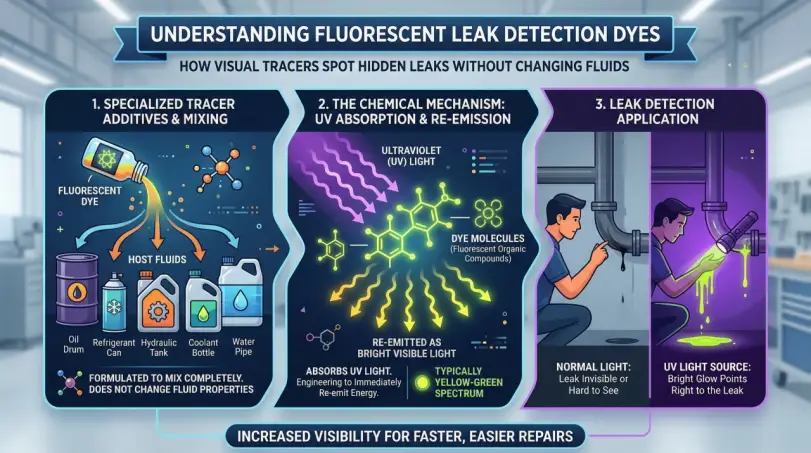
Fluorescent leak detection dyes are specialized tracer additives formulated to mix completely with a host fluid—such as oil, refrigerant lubricant, hydraulic fluid, water, or coolant—without changing its properties. Chemically, these are fluorescent organic compounds engineered to absorb ultraviolet (UV) light and immediately re emit it as bright visible light, typically in the yellow green spectrum.
In practice, a technician injects a small, measured volume of Fluorescent Leak Detection Dye into a closed loop system and allows it to circulate under normal operating conditions. As soon as any of the fluid escapes through a crack, pinhole, seal wear, or fitting, the dye escapes with it and accumulates at the leak point, where it glows clearly when scanned with a 365 nm UV inspection lamp.
The Science: How Fluorescent Leak Detection Dye Works
Fluorescence and UV A excitation
Fluorescence is a photochemical process where a molecule absorbs energy at one wavelength and re emits it at a longer wavelength almost instantly. In leak detection, the dye molecules are designed to absorb ultraviolet light in the UV A range around 365 nanometers (nm) and emit visible yellow green light that is highly conspicuous even in busy industrial environments.
The 365 nm wavelength is not arbitrary: major non destructive testing (NDT) standards such as ISO 9934 3 and ISO 3452 4 specify this band because it maximizes dye brightness while minimizing visible light interference. Sunlonge’s dyes and LED lamps are tuned precisely to this 365 nm “sweet spot” to generate extremely bright fluorescence and clean contrast at leak sites.
Circulation, escape and accumulation
In a working system, the dye behaves exactly like the host fluid—if it is mixed into engine oil, it flows through pumps, bearings, galleries, and return lines with that oil; if mixed into chilled water, it follows all pipes, valves, and heat exchangers. For most systems, 15–30 minutes of normal operation is enough to distribute the dye uniformly through all passages and components.
When fluid escapes, the lighter solvent fractions evaporate or disperse, but the larger dye molecules tend to remain on the surface of the leak site and nearby surfaces. Over time—even at very low leak rates—this creates a concentrated fluorescent “halo” at the exact failure point, which becomes immediately visible during UV inspection. This accumulation mechanism is why fluorescent dye can reveal leaks as small as under 1 gram per year in well designed systems.
Step by Step: How It Works in Industrial Systems
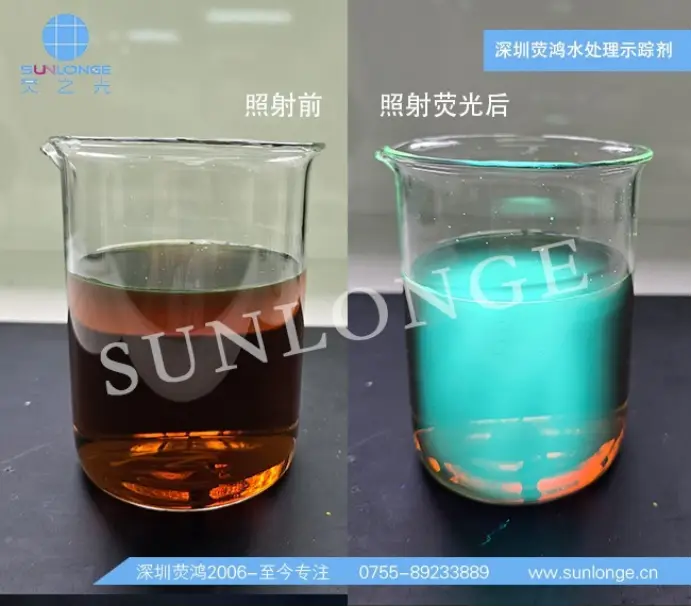
A typical Fluorescent Leak Detection Dye procedure in an industrial or HVAC system follows three core stages.
- Dye injection
- A calculated dose of dye is introduced via a reservoir, service port, or filler neck, based on total system fluid volume and recommended parts per million (PPM) ratios.
- For example, Sunlonge’s SL3200 oil soluble dye is often used at 500 PPM for engine oil and 500–2,000 PPM for hydraulic and transmission fluids, meaning 1 liter of dye can treat roughly 1,000–2,000 liters of system fluid.
- System circulation
- The system is run under normal load so the dye disperses uniformly, typically for 15–30 minutes, longer for very large or complex circuits.
- In hydraulics, operators will cycle actuators and valves through their full stroke; in HVAC systems, the compressor is allowed to cycle several times to move dye through evaporators and condensers.
- UV inspection
- Technicians dim ambient light where possible and scan all potential leak locations with a 365 nm UV A lamp: fittings, welds, gaskets, shaft seals, heat exchangers, hoses, and previous stain areas.
- Every active leak appears as a bright, high contrast fluorescent spot, often revealing multiple independent leak sites in one inspection pass that would be missed by pressure decay alone.
Because the dye can remain safely in many systems, repeat inspections later in the maintenance cycle become even faster: any new leak will immediately stand out under UV light using the same Fluorescent Leak Detection Dye already in circulation.
Key Industrial Use Cases
Pipelines, cooling loops, and process systems
In pipelines and cooling loops, fluorescent dyes are widely used to detect leaks of water, glycol, and process liquids. In large plants, leak detection is often implemented as a permanent preventive maintenance process, with dye continuously present in the fluid so operators can quickly identify new leak points during scheduled UV inspections.
Sunlonge’s water soluble dyes (such as SL3100 and SL3500) are developed specifically for these applications and can treat up to 3,000 liters of water based fluid per liter of dye, making them very economical for large volume systems.
Hydraulic and lubrication systems
Hydraulic power packs, presses, CNC machines, and lubrication loops operate at high pressure and are extremely sensitive to micro leaks that can cause directional control issues, loss of actuator speed, and overheating. Traditional pressure tests often struggle to distinguish between internal leakage (inside valves or actuators) and external leakage (fittings, hoses), leading to long diagnostic cycles.
Fluorescent Leak Detection Dye clarifies this immediately: internal leaks often produce internal fluorescent staining patterns at component joints, while external leaks show clear glowing streaks on outer surfaces. Industrial users report 30–50% reductions in diagnostic downtime by incorporating UV dye leak detection into their troubleshooting workflow.
HVAC, refrigeration and compressors
In HVAC and refrigeration, even very small refrigerant leaks drive up compressor run time and power consumption while also risking environmental non compliance. A 5–10 gram per month refrigerant leak in a large chiller can increase compressor run time by 15–20%, consuming thousands of extra kilowatt hours each year.
UV dye, circulating with compressor oil and refrigerant, escapes with any leak and pools at joints, braze connections, and service valves; under 365 nm light, these sites fluoresce bright green or yellow, allowing technicians to repair and re test quickly. Because of this reliability, UV dye detection is used by over 95% of professional MACS member A/C technicians as a primary method for refrigerant leak diagnosis.
Automotive and heavy vehicle systems
Fluorescent leak detection is now commonplace in engine oil, diesel, coolant, transmission, and power steering diagnostics. For example, Sunlonge’s SL3200 oil based dye is used by automotive and heavy equipment OEMs and service centers to trace leaks in gasoline and diesel engines by adding dye to engine oil and scanning with a high intensity UV lamp.
Sunlonge reports that its fluorescent dyes are accepted by major automotive customers such as Audi, GE, Honda and others, underlining their compatibility and performance in demanding OEM environments.
Why Fluorescent Leak Detection Dye Beats Traditional Methods
Before UV dyes became mainstream, technicians relied heavily on pressure decay tests, soap bubble tests, and visual inspection. While these still have a role, they suffer major limitations:
- Pressure decay tests show that “something is leaking” but not where, and often require long hold times to detect very small leaks.
- Soap bubble methods are labor intensive, messy, and insensitive to micro leaks below roughly 1–2 milliliters per minute.
- Visual inspection depends on visible staining or pooling, so leaks are only found after they have already caused significant fluid loss or contamination.
By contrast, high quality fluorescent dyes:
- Provide up to 100× higher sensitivity than bubble testing for small leaks, especially when paired with true 365 nm UV A lamps.
- Detect multiple leaks in a single pass, because every leak site glows independently under UV light.
- Deliver immediate visual confirmation suitable for photos, reports, and regulatory documentation (e.g., for EPA Section 608 leak repair requirements in HVAC).
For many plants, this translates into shorter outages, fewer callbacks, and more predictable maintenance planning.
Why Sunlonge’s Fluorescent Leak Detection Dyes Are Better
Sunlonge International is a Hong Kong–based specialist in fluorescent dyes and industrial UV inspection lamps, active in NDT and leak detection since 1999. Over more than two decades, the company has built proprietary dye formulations and high intensity LED UV lamp platforms that are tightly matched to each other, giving Sunlonge a performance edge over many generic dye or flashlight suppliers.
- Higher concentration formulations (more brightness, lower cost)
Many “standard” leak detection dyes on the market treat roughly 1,000–1,500 liters of fluid per liter of dye. Sunlonge’s SL3200 oil soluble dye is formulated at significantly higher fluorescent dye loading, enabling treatment ratios around 1:2,000–3,000 in engine, diesel, gear, and hydraulic oils.
This has three direct benefits:
- Brighter fluorescence: Higher dye concentration produces a much more intense yellow green glow, making leaks obvious even in partially lit industrial areas.
- Faster detection of micro leaks: Because more dye is available per unit of leaked fluid, tiny leaks reach a visible threshold sooner.
- Lower cost per inspection: Sunlonge estimates that its high concentration dyes can bring the chemical cost per inspection down to roughly 2–5 USD, versus around 5–10 USD for many OEM branded alternatives.
For water based systems, the SL3100 water soluble dye reaches a 1:3,000 concentration ratio (1 liter treats 3,000 liters of water based fluid), which is 1.5–3 times more economical than typical competitors at 1:1,000–1,2,000.
- Extreme temperature stability
Most commodity fluorescent dyes are designed for moderate temperatures, roughly from −20 °C up to about 100 °C, which is adequate for many automotive and HVAC tasks but limiting for harsher environments. Sunlonge’s SL3200, by contrast, is specified to maintain fluorescent performance from −40 °C all the way to +400 °C.
That extended range supports:
- Arctic or high altitude operations where outdoor temperatures routinely fall below −30 °C.
- On engine diagnostics around turbochargers, exhaust manifolds, and other hotspots where surface temperatures exceed 200 °C.
- Industrial furnace and kiln peripheral cooling systems that operate adjacent to structures at several hundred degrees Celsius.
This durability means one Fluorescent Leak Detection Dye product can cover a far broader range of equipment and climate conditions with confidence.
- Proven material compatibility and system safety
Sunlonge’s dyes are formulated as inert additives that do not react chemically with typical system materials—metals, elastomers, or plastics—and can remain in many systems indefinitely without causing corrosion, sludge formation, or seal degradation. SL3200, for example, is compatible with common automotive and industrial oils and is safe for use with typical rubbers (NBR, Viton), aluminum, steel, copper, and polymeric components.
This stable, additive only approach is one reason Sunlonge dyes have been adopted by demanding heavy automotive customers such as Audi, GE, and Honda.
- Integrated UV lamp technology optimized at 365 nm
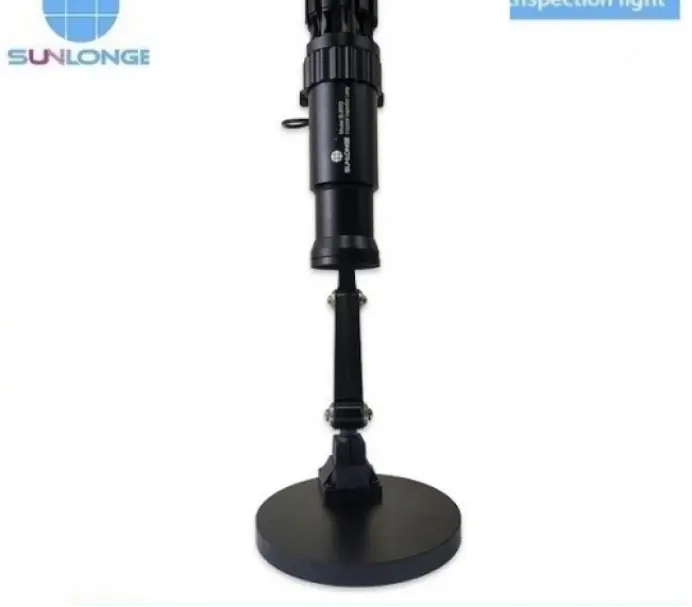
A critical, often overlooked element of leak detection performance is the UV lamp. Sunlonge designs and manufactures its own LED UV inspection lamps, mastering multi lens LED optics to deliver very high UV A intensity at 365 nm with compact, ergonomic designs.
Key lamp advantages include:
- True 365 nm emission exactly matched to the absorption peak of Sunlonge dyes, maximizing fluorescence.
- Intensity from about 21,000 μW/cm² for portable lamps up to 150,000–400,000 lux in specialized industrial and wafer inspection models, far above the 1,000–5,000 lux of many generic UV flashlights.
- Instant on, long life LED technology with 30,000+ hour lifespans, no warm up time, and no mercury or ozone generation—unlike mercury vapor lamps that need several minutes to stabilize and have only 500–2,000 hours rated life.
Because the dyes and lamps are engineered as a system, Sunlonge can guarantee that its Fluorescent Leak Detection Dye delivers maximum brightness and contrast under its own UV lamps, a combination difficult to match by mixing generic dyes with off the shelf lights.
- Standards, certifications, and regulatory readiness
Sunlonge’s leak detection solutions are designed to comply with major international NDT and HVAC/refrigeration standards, including:
- ASTM E2297 and ASTM E3022 for UV lamp performance and LED UV lamp requirements.[12][1]
- ISO 9934 3 and ISO 3452 4 for fluorescent inspection in magnetic particle and penetrant testing.
- EN 14624 for refrigerant leak detectors and EPA Section 608–compliant leak detection practices in HVAC/R.
This standards alignment gives OEMs, service providers, and industrial end users confidence that Sunlonge’s fluorescent dyes and lamps meet the technical benchmarks required for audits, certifications, and environmental compliance programs.
- Global footprint and application know how
Sunlonge’s UV inspection products are exported to more than 30 countries, and the company emphasizes custom, non standard UV lamp development—multiple optical lenses and custom beam profiles—to match specific inspection scenarios. Combined with domain content around pipelines, HVAC, automotive, and general NDT, this gives Sunlonge a strong ability to advise on dye selection, dosage, lamp choice, and inspection workflow, rather than only shipping a commodity chemical.
Important Technical Information at a Glance
Below is a compact, SEO friendly table you can reuse or adapt on your site for prospects comparing solutions.
| Aspect | Sunlonge Details |
| Detection mechanism | Fluorescent dye circulates with system fluid, escapes at leak sites, and glows bright yellow green when illuminated with 365 nm UV A light. |
| Main dye products | SL3200 oil soluble fluorescent dye; SL3100 and SL3500 water soluble dyes for pipelines, cooling water, and other aqueous systems. |
| Typical concentration ratios | SL3200: ~1:2,000–3,000 (1 L treats ~1,000–2,000 L oil); SL3100: 1:3,000 (1 L treats 3,000 L water based fluid). |
| Temperature range (SL3200) | Stable from −40 °C to +400 °C for harsh automotive and industrial environments. |
| Typical circulation time | 15–30 minutes under normal operation; longer for very large or complex systems. |
| Micro leak sensitivity | Detection of leaks below 1 gram per year under suitable inspection conditions. |
| Compatible systems | Automotive oils, diesel, gear and hydraulic oils, water and glycol loops, HVAC and refrigeration circuits, industrial hydraulics, and manufacturing quality control. |
| UV lamp technology | 365 nm LED UV lamps delivering ~21,000 μW/cm² in portable units and up to 150,000–400,000 lux for industrial/wafer inspection. |
| Lamp advantages vs mercury vapor | Instant full brightness, 30,000+ hour life, low power consumption, no mercury, no ozone, cooler housings, and higher durability. |
| Standards & compliance | Designed to meet ASTM E2297/E3022, ISO 9934 3, ISO 3452 4, EN 14624, and EPA Section 608 leak detection requirements. |
| Cost per inspection | Approximately 2–5 USD per inspection using Sunlonge dyes, versus around 5–10 USD with many OEM grade competitors. |
FAQs: Fluorescent Leak Detection Dye in Industrial Systems
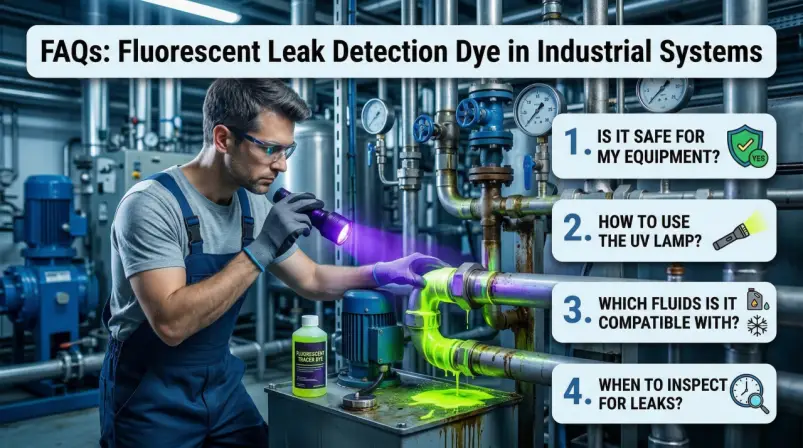
Q1. Will fluorescent dye damage my engine, compressor, or hydraulic system?
High quality dyes such as Sunlonge’s SL3200 and SL3100 are engineered as inert additives that do not chemically react with common system materials, including metals, elastomers, and plastics. They are compatible with typical automotive and industrial oils and water based fluids and can remain in many systems for their entire service life without causing corrosion, sludge, or seal hardening.
Q2. Does dye affect lubricant performance or refrigerant efficiency?
When dosed at recommended PPM levels (e.g., 500–2,000 PPM depending on fluid type), the dye concentration is extremely low compared with base fluid volume and is not enough to measurably affect viscosity, lubricity, or refrigerant thermodynamic performance. In HVAC/R, UV dyes are routinely used in systems that must comply with F Gas and EPA regulations, which would not be possible if dye compromised efficiency or reliability.
Q3. Will the dye clog filters or orifices?
Sunlonge’s fluorescent dyes are fully soluble in their intended host fluids and designed to pass freely through filters, orifices, and expansion valves without precipitating. When the system is operated within normal temperature and pressure limits and the correct dye type is chosen (oil soluble vs water soluble), clogging issues are extremely rare.
Q4. Can the dye stay in the system permanently?
For most automotive and industrial oil systems, the dye can safely remain indefinitely and continue to serve as a preventive maintenance tracer for future inspections. In very sensitive or regulated applications, operators may choose to flush and refill fluids after leak repair, but in typical practice, leaving the dye is standard and cost effective.
Q5. How much Fluorescent Leak Detection Dye should we add?
The correct dosage depends on fluid volume and type. As general guidance for Sunlonge SL3200: around 500 PPM for engine oils, 700–2,000 PPM for diesel and gear oils, and 500–2,000 PPM for hydraulic and transmission fluids. For SL3100 in water based loops, a 1:3,000 ratio (1 liter dye per 3,000 liters water based fluid) is typical. Always follow the product datasheet or Sunlonge technical guidance for exact recommendations.
Q6. How quickly can we find leaks after adding dye?
In many systems, leaks can be detected as soon as the dye has completed one or several full circulation cycles—often within 15–30 minutes of normal operation. For very small micro leaks or very large systems, overnight operation may produce stronger accumulation and easier detection, but standard maintenance windows are usually sufficient.
Q7. Is UV dye suitable for high temperature or very cold environments?
Yes, provided you choose a dye formulated for those extremes. Sunlonge’s SL3200 maintains its fluorescent properties from −40 °C up to +400 °C, covering most real world automotive, industrial, and energy sector applications worldwide. This makes it particularly attractive for operators with both cold climate outdoor assets and high temperature engine or furnace adjacent equipment.
Q8. What makes Sunlonge a better partner than generic dye suppliers?
Sunlonge offers an integrated solution—high concentration, application specific fluorescent dyes; high intensity 365 nm LED lamps; and deep application support across automotive, HVAC, pipeline, and NDT markets. Their products are designed to meet key ASTM, ISO, EN, and EPA standards, are already proven with tier 1 OEMs, and are deployed in more than 30 countries, giving you a lower total cost of ownership and a higher probability of “first time right” leak diagnosis compared with piecing together generic dyes and flashlights.