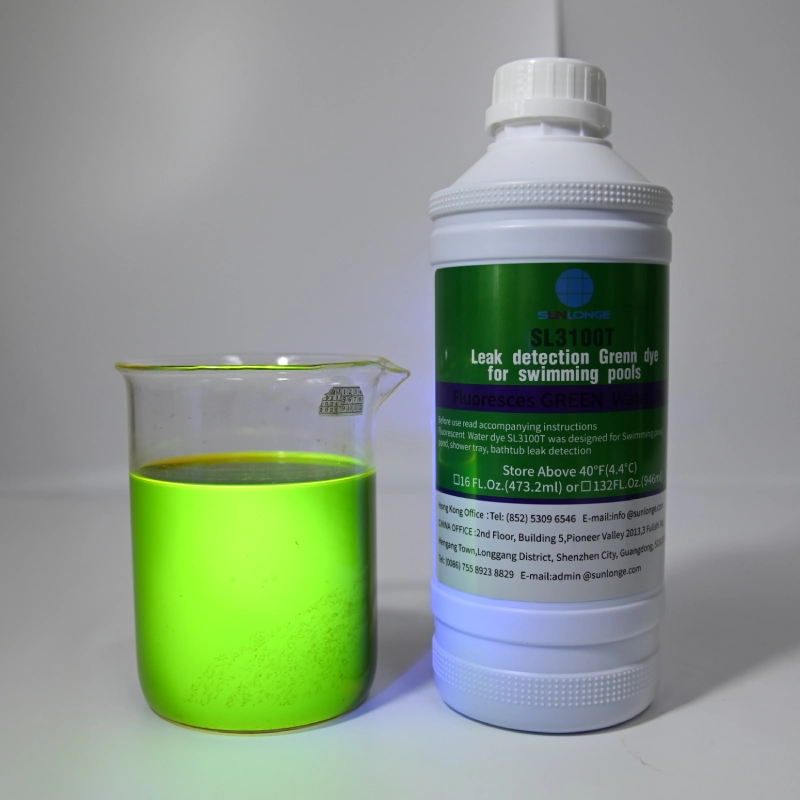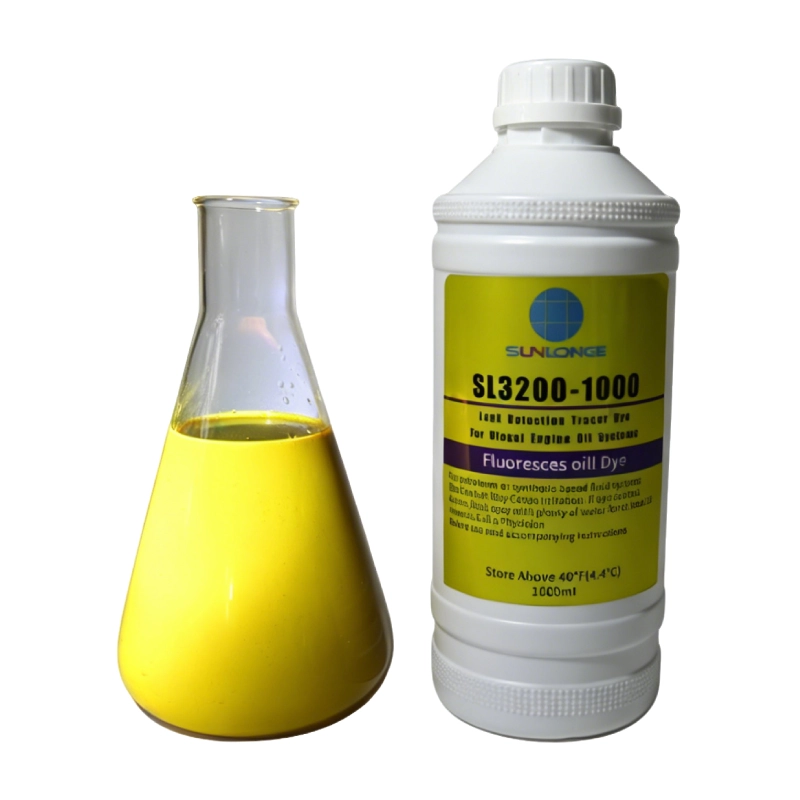
A maintenance manager buys a one-liter bottle of fluorescent dye labeled “universal UV dye for all oil systems” and pours it into a 600-gallon hydraulic reservoir. Nothing fluoresces. The dye has separated into a milky layer floating on top of the hydraulic fluid. Three days of downtime later, the tank is drained, the lines flushed, and the leak search starts over with a properly matched dye. The dye cost was small. The downtime cost was not.
Choosing the wrong UV dye for an oil system is one of the most expensive mistakes in fluorescent leak detection. An oil-soluble fluorophore that tries to dissolve in a polar ester-based hydraulic fluid will precipitate, float to the surface or settle to the bottom of the tank, and produce zero fluorescence at leak points. The technician sees nothing under UV light and assumes there are no leaks, which is worse than knowing there are leaks you cannot find.
Choosing the right UV dye for an oil system means matching the dye carrier chemistry to the base oil chemistry, verifying that the dye’s rated temperature range covers both cold-start and hot-spot extremes, confirming seal and elastomer compatibility, calculating dosage for the specific fluid volume, and ensuring the dye’s excitation peak matches the UV inspection lamp’s emission peak. A dye that fails any one of these checks will not produce reliable fluorescence and may damage the system.
The selection process breaks into five core steps: base oil match, temperature match, seal match, dosage, and lamp match. Each step has a clear pass or fail criterion. Most dye failures in the field trace back to skipping one of these checks under time pressure, not to any inherent complexity in the technology. This article walks through each step and closes with the most common mistakes to avoid.
Match the Dye to Your Base Oil Chemistry
The most important selection criterion for a UV dye for oil is whether its carrier chemistry dissolves fully in your base oil across the full operating temperature range. A dye rated for mineral oil will not dissolve in a phosphate ester hydraulic fluid. The failure shows up as phase separation, precipitation, or complete loss of fluorescence.
The fluorophore molecules in UV dyes are hydrophobic by design, carrying hydrocarbon or aromatic side chains that are chemically similar to mineral oil, synthetic hydrocarbons (PAO), and polyol ester base stocks. But the polarity, molecular weight, and hydrogen-bonding profile of those base stocks varies widely. A dye dissolved in mineral oil at room temperature may drop out of solution in cold PAO at 0 degrees Celsius because the polymer chains in PAO are more rigid at low temperatures and cannot accommodate the dye molecules. A dye formulated for PAO may not dissolve in polyalkylene glycol (PAG) at all, since PAG is partially polar and rejects pure hydrocarbon fluorophores.
The table below summarizes the major base oil chemistries and which dye family is compatible with each.
| Base Oil Type | Common Applications | Compatible Dye Family |
|---|---|---|
| Mineral Oil (paraffinic, naphthenic) | Engine oil, hydraulic oil, gear oil | Standard oil-soluble dye |
| Synthetic Hydrocarbon (PAO) | High-temp hydraulic, gear oil, compressor oil | Standard oil-soluble dye |
| Polyol Ester (POE) | Aviation turbine oil, refrigeration compressors | Specialty ester-compatible dye |
| Phosphate Ester | Aircraft hydraulics, some industrial hydraulics | Aviation-grade phosphate ester dye |
| Polyalkylene Glycol (PAG) | High-temp gear oil, some compressor oil | Specialty PAG-compatible dye |
| Alkylbenzene | Refrigeration compressors | Refrigeration oil dye |
| Vegetable oil (natural ester) | Marine and hydraulic applications | Bio-based oil dye |
To identify your base oil, check the equipment manufacturer’s lubrication guide, the oil container label, or the safety data sheet (SDS). Most industrial oils list the base stock type explicitly. If the documentation only lists the ISO VG grade (32, 46, 68, 100, 150) without specifying base stock chemistry, request the technical data sheet from the oil supplier. For unknown systems in legacy equipment, a quick bench test resolves the question before injecting any dye.
For most industrial hydraulic and automotive engine applications, UV dye for oil formulated for mineral and synthetic hydrocarbon base stocks covers the application. Specialty applications (aviation, high-temperature compressors, biodegradable systems) require purpose-built dyes, and the cost of a wrong dye in those systems can include not just wasted inspection time but also seal damage and additive depletion.
Verify the Operating Temperature Range
A UV dye must remain chemically stable and fully dissolved at both the lowest cold-start temperature and the highest hot-spot temperature the system will reach during operation. Dyes rated only for “ambient use” will not survive a turbocharger bearing at 220 degrees Celsius or a winter startup at minus 30 degrees Celsius.
At the low end, a dye injected into a cold hydraulic reservoir at minus 5 degrees sees an immediate viscosity spike and slow circulation. If the dye falls out of solution at low temperatures, it will not redissolve cleanly after the system warms up, and the resulting gel-like deposits can clog filters and servo valves. At the high end, the failure mode is thermal decomposition. Fluorescent dyes rely on intact conjugated ring systems to absorb and re-emit light. When those structures break down under heat, the dye loses its fluorescence. Most oil-soluble dyes have an upper temperature limit between 150 degrees and 200 degrees Celsius.
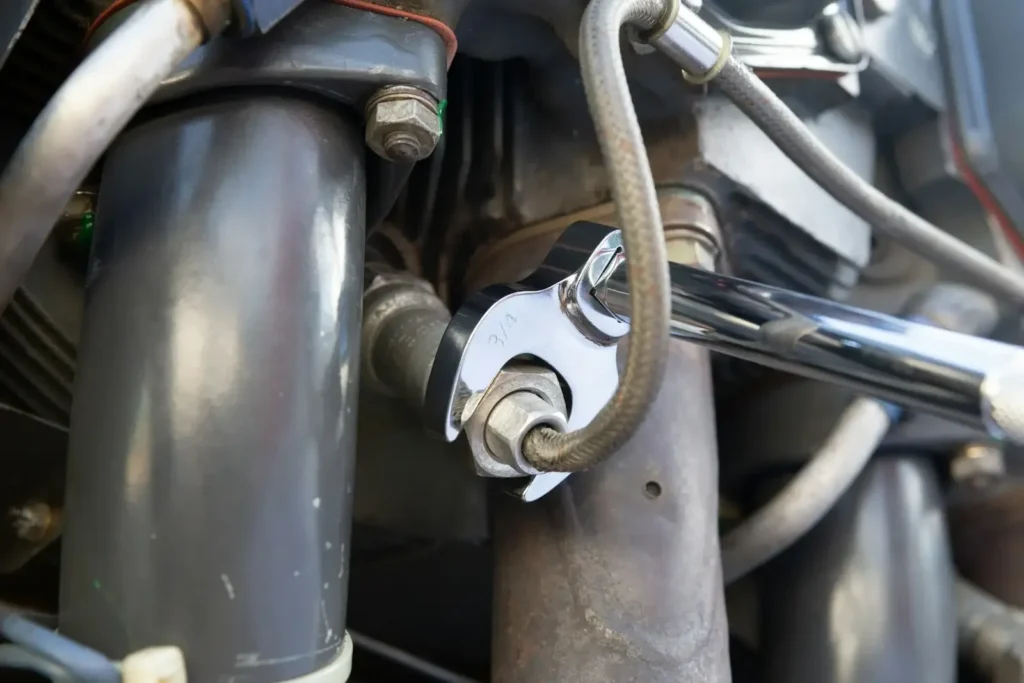
The practical issue is that hot-spots in a machine are not the same as bulk oil temperature. A hydraulic reservoir may sit at 50 degrees, but the bearing housing at the output shaft of a gearbox can reach 180 degrees because that is where the mechanical load converts to heat. A turbocharger bearing in a diesel engine reaches 220 degrees during sustained high-load operation. The dye circulates through these hot-spots every few minutes and degrades quickly even if the bulk reservoir temperature stays modest.
To select a dye that survives your operating environment, build a temperature profile that includes minimum startup temperature (coldest ambient the system will experience), normal bulk operating temperature, hot-spot temperatures (bearing housings, gear meshes, compressor stages), and maximum transient temperature during abnormal operation. Each UV dye has a technical data sheet listing a continuous-use temperature range. The dye must cover the lowest cold temperature through the highest hot-spot. If the data sheet says “operating range 0 degrees to 150 degrees Celsius,” that dye is not suitable for a system that sees minus 20 degree winters or 180 degree bearing housings.
Check Seal and Elastomer Compatibility
Oil-soluble UV dyes are chemically inert toward standard seal materials (NBR, HNBR, FKM, PTFE) at the concentrations used for leak detection (0.1% to 0.5% by weight). Systems with less common elastomers (EPDM, FFKM, silicone) or advanced seal aging may show swelling, hardening, or weight change when a foreign additive is introduced. Verify compatibility with a bench test before injecting dye into any large system.
The seal sees a 99.5% to 99.9% oil charge with a trace amount of dye additive. The other additives in the oil (anti-wear agents, viscosity index improvers, antioxidants, detergents) are at much higher concentrations and dominate the seal environment. Compatibility testing still matters for two reasons. First, older dye formulations used co-solvent carriers (acetone, toluene, MEK) to keep the fluorophore in liquid form during storage. These solvents can swell certain elastomers by 5% to 10% by volume, distort sealing geometry, and produce leaks that did not exist before the dye was injected. Modern co-solvent-free dyes avoid this problem. Second, specialty seal materials (perfluoroelastomers, silicone O-rings in food-grade equipment, EPDM in automotive brake systems) have narrow chemical compatibility windows and can react to additives that standard seals tolerate.
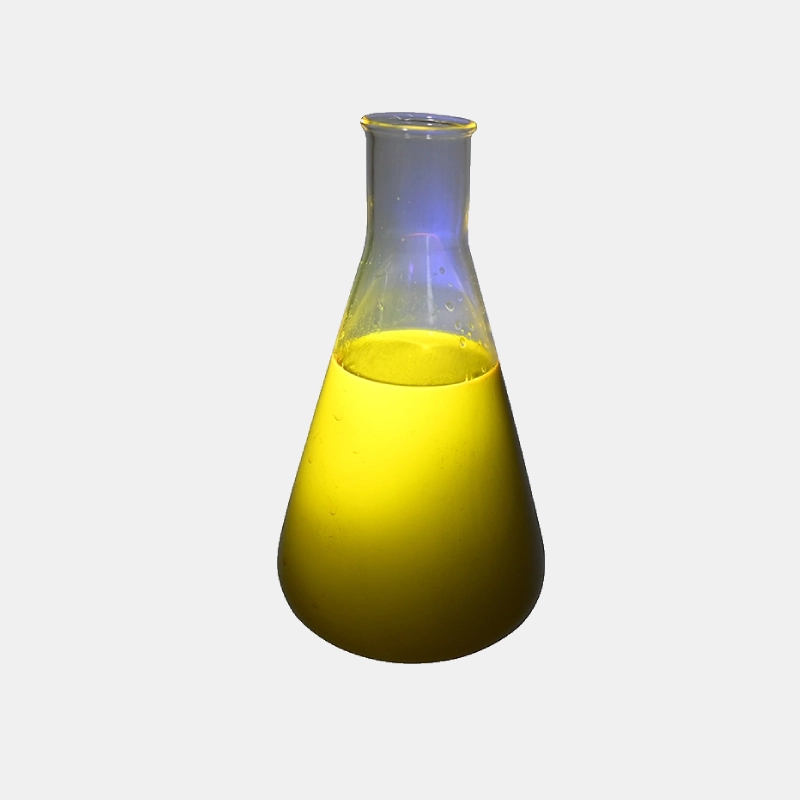
A change in Shore A hardness of more than 5 points, or a volume change exceeding 5%, indicates incompatibility. Within the portfolio of fluorescent leak detection dyes, seal-safe formulations are standard. The compatibility question is more about specific seal materials in specific equipment than about the dye chemistry itself. For air conditioning and refrigeration systems that use ester-based lubricants, similar testing applies, though the base oil chemistry is handled through the UV dye for HVACR category.
Calculate the Correct Dosage for Your System Volume
UV dye dosage scales with the total fluid volume of the system, not with the leak size or the machine size. The standard dose is one-quarter to one-half ounce per quart of oil for engine and small-system applications, and one ounce per 25 to 50 gallons for large industrial reservoirs. Overdosing wastes product and can alter oil properties; underdosing produces fluorescence too dim to see under shop lighting.
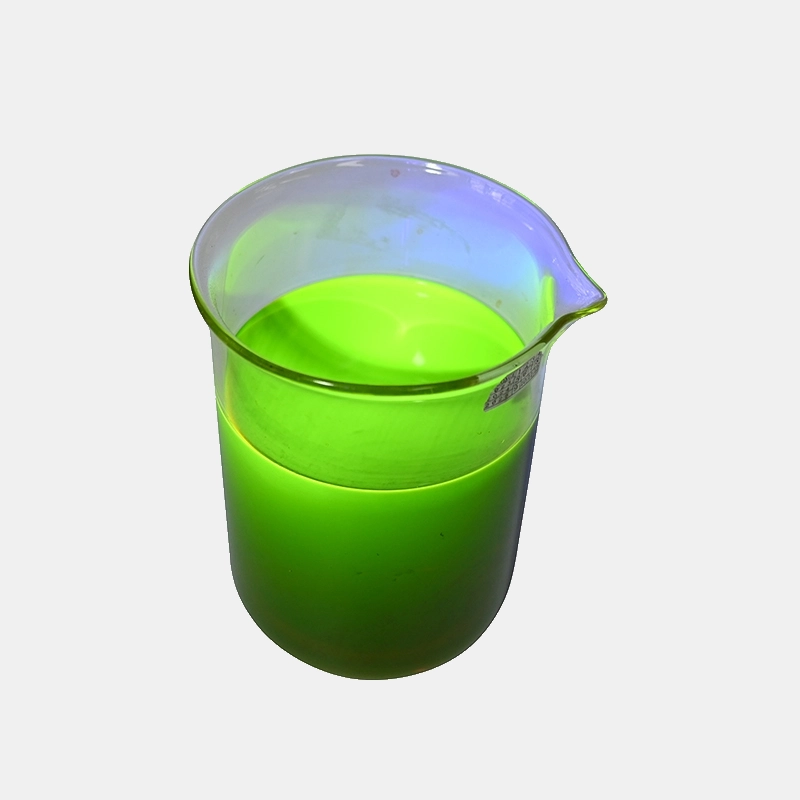
The dye concentration sets the brightness of the fluorescence at the leak point. At very low concentrations, the fluorescence is visible only in a dark inspection environment. At the standard concentration, it is bright enough to see under most shop lighting conditions, which is the practical target for field inspections. At two to three times the standard concentration, the fluorescence is very bright but the oil in the sight glass may turn visibly yellow-green.
A practical concern with very large systems is the cost and handling of the dye. A 2,000-gallon hydraulic reservoir dosed at one ounce per 50 gallons needs 40 ounces of dye, which is over a liter. Some manufacturers offer concentrated dyes for large systems that reduce the injection volume by a factor of three or four while maintaining the same fluorescence yield per gallon.
| System Type | Typical Oil Capacity | Recommended Dye Dose |
|---|---|---|
| Small engine (motorcycle, lawn equipment) | 1 to 4 quarts | 0.25 to 0.5 oz per quart |
| Automotive engine (sedan, light truck) | 4 to 8 quarts | 0.25 to 0.4 oz per quart |
| Heavy-duty diesel engine | 15 to 50 quarts | 0.2 to 0.3 oz per quart |
| Small industrial hydraulic | 20 to 100 gallons | 1 oz per 20 to 25 gallons |
| Medium industrial hydraulic | 100 to 500 gallons | 1 oz per 25 to 40 gallons |
| Large industrial hydraulic | 500 to 5,000 gallons | 1 oz per 40 to 50 gallons |
| Gearbox (industrial) | 5 to 100 gallons | Match hydraulic equivalent |
| Diesel fuel system | 10 to 100 gallons | 0.05% to 0.1% concentration |
For automotive engine applications, the SL3200 UV dye for engine oil arrives in pre-measured doses calibrated to common sump capacities (4, 5, 6, and 8-quart engines). The instructions on the bottle specify how much to add for each engine size, which removes the calculation step for the most common automotive use case.
For industrial hydraulic systems, the dose is calculated for the total reservoir capacity, not the flow rate or operating pressure. After injecting the dye, run the system to let it circulate: about 10 minutes of idle for a small engine, 30 to 60 minutes for a 500-gallon hydraulic reservoir with a 50-gpm circulation rate. For circuits with many branches, cycle each actuator through its full stroke to push dye into lines that would otherwise see only static oil.
Match the UV Lamp Wavelength to the Dye
A UV dye is only as bright as the lamp that excites it. A dye optimized for 365 nm excitation will appear dim under a 395 nm lamp. Wavelength match is the single biggest determinant of whether an inspection succeeds or fails, often more important than lamp power.
The dye and the lamp are often purchased separately. The dye is selected based on oil chemistry and system characteristics. The lamp is selected based on price, brand, or whatever the shop already owns. If the two are not a matched set, the inspection result suffers.
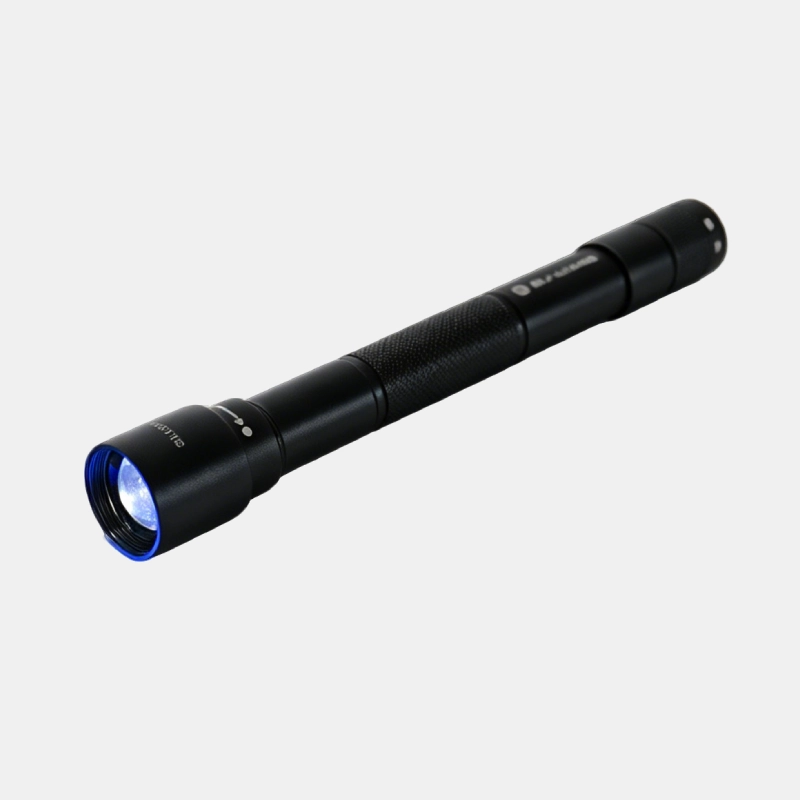
Lamp specifications list their peak emission wavelength in nanometers. Common values are 365 nm, 370 nm, and 395 nm. For oil-soluble UV dyes, the relevant peak is the primary UV emission, almost always in the 365 to 370 nm range. Dye specifications list the optimal excitation wavelength and the resulting emission wavelength. For oil-soluble dyes that contain perylene or naphthalimide fluorophores, the optimal excitation peak is in the 360 to 370 nm range, and the emission is in the 500 to 540 nm yellow-green range.
The mismatch case most often seen in field service is using a 395 nm lamp with a 365 nm dye. The lamp emits at 395 nm, closer to the violet end of the visible spectrum. The dye still absorbs some energy at that wavelength, but the absorption cross-section is dramatically lower than at 365 nm. The result is dim fluorescence that requires a darkened inspection area. The technician assumes the dye is too weak and adds more. The dye concentration climbs above target range. Eventually the oil in the sight glass turns visibly yellow-green.
The solution is straightforward: check the dye’s excitation peak on the technical data sheet, check the lamp’s emission peak on its specification label, and match them within 5 to 10 nm. If the existing lamp does not match, replace it. Field test: inject dye into a small oil sample, apply drops to white paper, and scan with the lamp. If the spot is bright with the room lights on, the match is good. If visible only in a darkened area, a different lamp is needed.
Assess Additive Compatibility and Long-Term Stability
An oil system is rarely pure base oil. It contains anti-wear agents (ZDDP), detergents, dispersants, antioxidants, viscosity index improvers, and pour point depressants. A UV dye must remain fluorescent and chemically stable in the presence of these additives for the full oil service interval, which can be thousands of operating hours in industrial systems.
Standard additives such as ZDDP (zinc dialkyldithiophosphate, used as an anti-wear agent in engine oils and hydraulic fluids) do not interact strongly with oil-soluble fluorophores at leak-detection concentrations. The dye is chemically inert with respect to ZDDP, detergents (calcium and magnesium sulfonates), dispersants (polyisobutylene succinimide), and oxidation inhibitors (hindered phenols, aromatic amines).
Risk factors include synthetic engine oils marketed for extended drain intervals (15,000 to 25,000 miles) that use higher treat rates of antioxidants and additional dispersants. The higher dispersant concentration can, in theory, solubilize and disperse the dye more aggressively, leading to lower apparent fluorescence. The dye is still in the oil, but its optical output is reduced. This is unlikely to prevent detection in practice but may require a slightly higher dose. Industrial hydraulic fluids that are zinc-free (driven by environmental regulations on zinc discharge) use ashless phosphorus or boron-based additives and are generally compatible, though a bench test is worth running before a large-reservoir injection.
A practical compatibility test: mix the dye at the intended concentration with a 250 mL sample of the system oil. Heat the sample to the system’s normal operating temperature for 24 hours. Allow it to cool, then place a few drops on white paper and scan with a UV lamp. Compare the fluorescence brightness to a control sample of the same dye in reference mineral oil treated identically. If the test sample is visibly dimmer, the additive package is reducing dye performance. Standard oil-soluble dyes are tested for 5,000 to 10,000 hours of continuous use at 100 degrees Celsius without measurable fluorescence loss.
Common Selection Mistakes and How to Avoid Them
The most frequent selection errors are skipping the base oil chemistry check, ignoring the upper temperature limit, underestimating circulation time, and assuming any UV lamp will work. Each produces a failed inspection that may be misdiagnosed as “no leaks” rather than “wrong dye.”
Mistake 1: Assuming universal compatibility. Universal dye labels claim “works in all oil systems.” The claim holds for mineral oil and PAO, but fails on phosphate ester, PAG, POE, and vegetable ester applications. For specialty systems, always request a manufacturer statement of compatibility with your specific base oil and seal material.
Mistake 2: Ignoring the upper temperature limit. A dye rated to 150 degrees Celsius will not survive a turbocharger bearing at 200 degrees. The dye degrades silently, and fluorescence fades by the end of the inspection shift. Check hot-spot temperatures against the dye’s upper limit with at least 20 degrees of margin.
Mistake 3: Not running the system long enough. A 500-gallon hydraulic reservoir needs at least 30 minutes of full circulation. Five minutes of runtime produces fluorescence only in lines near the reservoir, missing leaks in remote branches.
Mistake 4: Buying the wrong lamp. A 395 nm lamp with a 365 nm dye produces dim fluorescence. Buy the lamp that matches the dye, and store the two together so the next shift knows which goes with which.
Mistake 5: Skipping the bench test. A bench compatibility test costs an hour of technician time and a small oil sample. A failed injection into a large industrial system costs a full day of downtime to drain, flush, and refill.
Mistake 6: Overdosing. Dim fluorescence on the first scan is usually a circulation or wavelength problem, not a concentration problem. Stop adding dye after the first dose, run the system for another 15 minutes, and re-scan.
When in doubt about any selection criterion, contact the dye manufacturer. Most suppliers of professional-grade leak detection solutions maintain technical support contacts staffed by chemists or engineers who can review your system specifications and recommend a specific product. For systems that do not fit any standard product profile (uncommon base stock, unusual seal material, extreme temperature, or regulatory restrictions such as food-grade or marine rules), custom dye formulation may be more cost-effective than maintaining inventory of multiple specialty dyes.
FAQ
Can one UV dye work for both engine oil and hydraulic oil?
In most cases, yes. Engine oils and common industrial hydraulic fluids share mineral and PAO base stocks. A standard oil-soluble dye formulated for mineral oil dissolves in both. The exceptions are hydraulic systems using phosphate ester fluids (Skydrol, Hyjet) and water-glycol or PAG base stocks, which require specialty dyes that the standard automotive dye cannot replace.
How do I test a UV dye before injecting it into a large system?
Take a 250 mL sample of the system oil and mix it with dye at the intended concentration. Place a sample of the system’s seal material or a representative O-ring in the container. Seal the container and heat it to the system’s maximum operating temperature for 168 hours. After cooling, check the seal for swelling, weight change, or hardness change. Place a few drops of the dyed oil on white paper and scan with a UV lamp. If fluorescence is bright and the seal is unchanged, the dye is compatible.
What happens if the dye precipitates inside the system?
Precipitated dye forms particles that can clog filters, restrict flow through narrow passages (servo valves, injector nozzles, bearing clearances), and coat surfaces with a sticky residue. The immediate effect is usually a filter alarm. The fix: drain the system, flush with clean oil, replace the filters, and refill with the correct dye. Bench compatibility testing prevents this failure mode entirely.